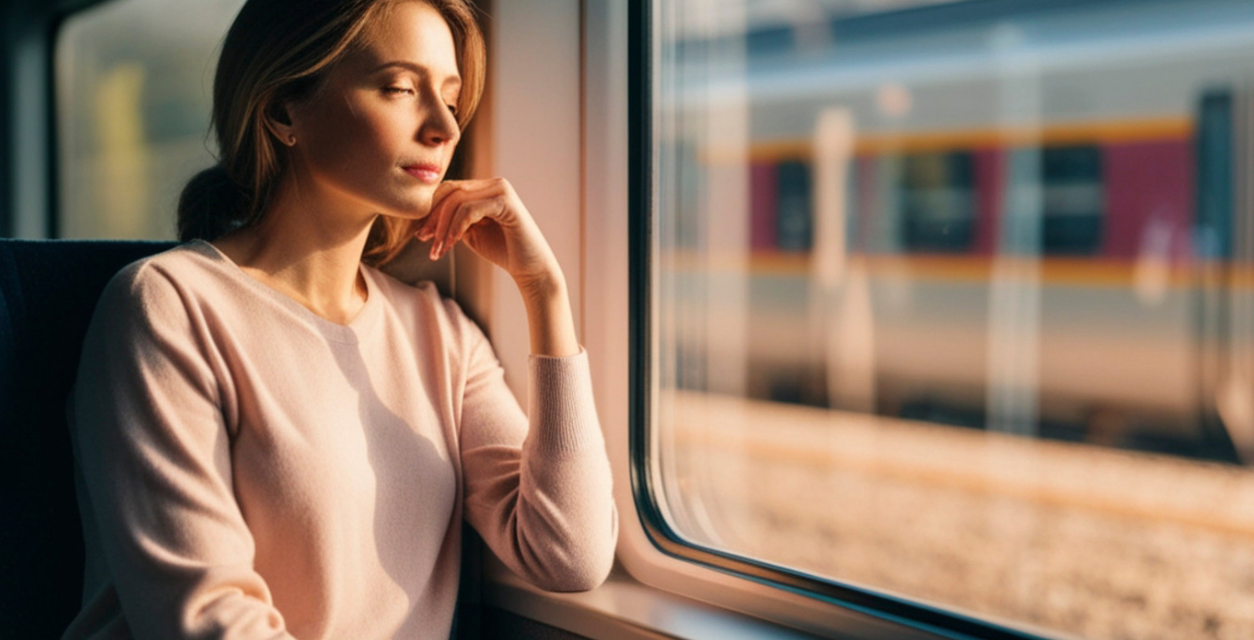
I recently took on a teaching assignment at a location I reach by train. It’s not new for me. I’ve ridden this line before. But there had been a long break, and I found myself really looking forward to it. The quiet platform. The rhythm of something larger than me moving forward. And then, on that first ride after the break, it landed in my body in a way it never quite had before: one of the things I love most about the train is how it holds me.
For thirty minutes, I don’t have to do anything. I don’t have to navigate traffic or decide which route to take. I don’t have to be alert in the way driving requires. I can work, or text a friend, or read, or simply stare out the window and watch neighborhoods and trees and sky pass by. The train carries me. It knows where it’s going. And somehow, without effort on my part, I arrive. There’s a quiet relief in that kind of holding—being in motion without having to be in charge of the motion.
Holding Steady
Sitting there, listening to the hum of the rails, I realized how rarely many of us experience that in our relationships. How often, especially as women, we are the ones doing the holding. Holding schedules and emotions. Holding family needs, partner stress, children’s worlds, workplace dynamics. Holding things together. Holding everyone else steady.
And how seldom we pause to ask:
Who, or what, is holding me?
Maybe some of us are fortunate enough to have partners or friends who could hold us in meaningful ways. But another, quieter question follows: do we actually let them? So many of us have learned to be the strong one, the capable one, the one who anticipates needs and smooths edges. Receiving can feel unfamiliar, even risky. We may long to be held, and yet instinctively brace when the moment comes—unsure how to soften into it, unsure whether it will last, unsure whether our needs are too much.
Being Held
And then there are seasons when the people who might hold us are themselves stretched thin. Illness, grief, work, caregiving, life. In those moments, the invitation isn’t to become more self-sufficient in a hardened way, but to become more creative about where and how holding can come. That ride on the train reminded me that sometimes holding doesn’t look like a pair of arms. Sometimes it looks like a system you can finally trust. A calendar that keeps track so your mind doesn’t have to. A routine that carries you when your energy is low. A quiet, reliable structure that says, “You don’t have to be on high alert right now. You will get where you need to go.”
And sometimes it looks like allowing small, real moments of being held with the people already in our lives—not in grand gestures, but in ordinary ones. A conversation that goes a little deeper. A coffee shared without rushing. Letting yourself say, “This is hard,” and staying in the room when someone responds with care.
Holding the Future
Lately, I’ve also been thinking about holding in a different direction: toward the future. What does it mean to hold the woman I will be a week from now? A month from now? A year from now? Not by pushing her to perform or demanding more productivity, but by offering her kindness in advance. Preparing a little space. Creating a little ease. Making choices today that say, “I am thinking of you. You won’t be alone when you get here.”
Maybe boundaries, in this light, are less about keeping others out and more about creating enough structure for rest, for trust, for gentleness to exist. Like the rails beneath the train, they don’t stop the journey. They make it possible to move forward without constant vigilance. And perhaps love, this season, isn’t only about how much we can hold for others. Perhaps it’s also about learning, slowly and tenderly, how to be held.
Find more from Jamie here.